



 |
|
Already registered? Download the App below! Having the app ready to go will help speed up check-in and reduce long lines when you arrive. It will also give you easy access to the schedule, session details, announcements, exhibitor information, networking features, and other important event updates.
|
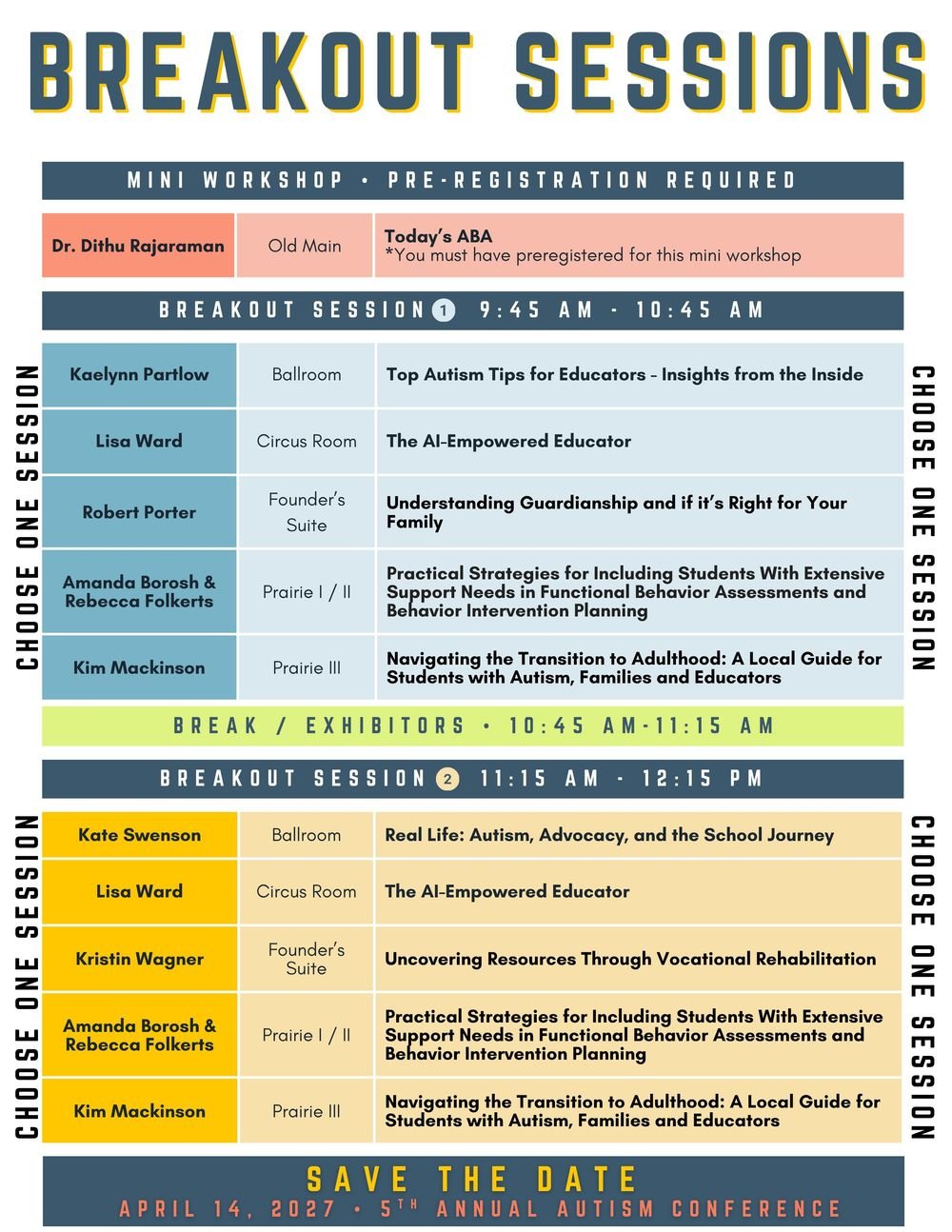
| Breakout Session 1: 10:00 AM - 11:00 AM |
|
Kaelynn Partlow: Top Autism Tips for Educators - Insights from the Inside Drawing from her dual experience as an autistic adult and a professional providing autism services, this presentation offers educators an “insider’s perspective” on how to better support autistic students. Kaelynn breaks down the why behind common autistic behaviors like sensory sensitivities, meltdowns, and rigidity, and explain them in ways that are both relatable and actionable. Using real-world clinical experience, she shares concrete strategies educators can implement to improve communication, redirect challenging behavior, reduce frustration, and adapt to change. Attendees will walk away with useful tools, and a deeper understanding of how autism can impact students. *This session will only be available for the first breakout session. |
|
Lisa Ward: The AI-Empowered Educator In this hands-on workshop, autism educators and administrators will move beyond the theory of Artificial Intelligence and into practical application. Participants will learn how to leverage tools to automate the most time-consuming aspects of special education—from drafting SMART goals and analyzing behavior data to creating high-interest, adapted curricula. We will focus on the "human-in-the-loop" model, ensuring that while AI does the heavy lifting, the teacher’s clinical expertise remains the final authority. By the end of this session, attendees will have a "Digital Teaching Assistant" ready to reclaim hours of their weekly planning time. *This session will be available for both breakout sessions. |
|
Robert Porter: Understanding Guardianship and if it is Right for Your Family This session will address when an individual should seek adult guardianship. We will discuss if guardianship is in fact needed or whether an alternative to guardianship would be effective. The session will then delve into the following: 1) the types of guardianship, 2) the steps required to obtain guardianship, 3) how an adjudication of disability affects a person under guardianship, 4) the rights of individuals under guardianship, and 5) the ongoing duties of a guardian. Questions from session participants are absolutely welcomed! *This session will only be available for the first breakout session. |
|
Amanda Borosh, M.Ed., BCBA & Rebecca Folkerts, PhD, BCBA-D: Practical Strategies for Including Students With Extensive Support Needs in Functional Behavior Assessments and Behavior Intervention Planning Students with extensive support needs, such as Level 3 autism, intellectual disabilities, and multiple disabilities, are more likely to engage in challenging behavior and are often excluded from decisions about the behavior supports they receive. Although function-based interventions are known to be more effective, students with significant communication, motor, or sensory needs are frequently left out of the functional behavioral assessment (FBA) and behavioral intervention planning (BIP) process. This presentation focuses on practical strategies for meaningfully including student voice by improving accessibility during student interviews and preference assessments. We share concrete, realistic strategies, backed by current research, to adapt student interviews and direct preference assessments for students with communication needs, orthopedic impairments, and sensory disabilities, with an emphasis on adjusting materials, response formats, environmental setup, and data-collection procedures. This session is ideal for school personnel who want to make FBAs and BIPs immediately more inclusive, effective, and student-centered. *This session will be available for both breakout sessions. |
|
Kim Mackinson: Navigating the Transition to Adulthood: A Local Guide for Students with Autism, Families, and Educators This breakout session is designed for teachers, parents, and students with autism who want clear, practical guidance on navigating the transition process from school to adult life at the local level. Transition planning can feel overwhelming, and many families are unsure when to begin, who to contact, or what services are available until it is too late. This session aims to close that gap with actionable, ground-level information. Participants will learn when the transition process should begin, why starting early matters, and how parents, educators, and students can work together to build a strong transition plan. The session will outline key local contacts and agencies involved in transition services, including how schools, families, and community partners connect with organizations such as DHS/DRS. This breakout will emphasize what happens before and alongside those services and what individuals and teachers can do day-to-day to support successful transitions. In addition, the session will address how parents and students can find and access resources through local marketing efforts, websites, and community networks. Tips for navigating websites, understanding available supports, and advocating effectively at the local level will be shared. Teachers will gain insight into how to better inform and guide families, while parents and students will leave with a clearer roadmap for taking the next steps in the transition journey. *This session will be available for both breakout sessions. |
| Breakout Session 2: 11:15 AM - 12:15 PM |
|
Kate Swenson: Real Life: Autism, Advocacy, and the School Journey Join parent and advocate Kate Swenson as she reflects back on her family’s journey through an autism diagnosis, early intervention, and transition to school services, and the emotional toll these processes can take on a family. In this presentation, she will discuss her son Cooper's educational journey to date and highlight the challenges both parents and educators can face in the world of special education. This presentation is humorous, hopeful, honest, and emotional and those who listen will walk away inspired. *This session will only be available for the second breakout session. |
|
Lisa Ward: The AI-Empowered Educator In this hands-on workshop, autism educators and administrators will move beyond the theory of Artificial Intelligence and into practical application. Participants will learn how to leverage tools to automate the most time-consuming aspects of special education—from drafting SMART goals and analyzing behavior data to creating high-interest, adapted curricula. We will focus on the "human-in-the-loop" model, ensuring that while AI does the heavy lifting, the teacher’s clinical expertise remains the final authority. By the end of this session, attendees will have a "Digital Teaching Assistant" ready to reclaim hours of their weekly planning time. *This session will be available for both breakout sessions. |
|
Kristin Wagner: Uncovering Resources Through Vocational Rehabilitation This session explores how Vocational Rehabilitation (VR) can serve as a critical partner in supporting individuals with disabilities as they prepare for, transition into, and succeed in the workforce. Participants will gain an overview of VR resources available during secondary education, including transition planning, career exploration, and pre-employment transition services. The session will also highlight supports available in postsecondary education and beyond, such as training assistance, workplace accommodations, and ongoing employment supports. Attendees will leave with a clearer understanding of how VR resources can be accessed and leveraged at each stage of the education-to-employment pathway to promote long-term career success. *This session will only be available for the second breakout session. |
|
Amanda Borosh, M.Ed., BCBA & Rebecca Folkerts, PhD, BCBA-D: Practical Strategies for Including Students With Extensive Support Needs in Functional Behavior Assessments and Behavior Intervention Planning Students with extensive support needs, such as Level 3 autism, intellectual disabilities, and multiple disabilities, are more likely to engage in challenging behavior and are often excluded from decisions about the behavior supports they receive. Although function-based interventions are known to be more effective, students with significant communication, motor, or sensory needs are frequently left out of the functional behavioral assessment (FBA) and behavioral intervention planning (BIP) process. This presentation focuses on practical strategies for meaningfully including student voice by improving accessibility during student interviews and preference assessments. We share concrete, realistic strategies, backed by current research, to adapt student interviews and direct preference assessments for students with communication needs, orthopedic impairments, and sensory disabilities, with an emphasis on adjusting materials, response formats, environmental setup, and data-collection procedures. This session is ideal for school personnel who want to make FBAs and BIPs immediately more inclusive, effective, and student-centered. *This session will be available for both breakout sessions. |
|
Kim Mackinson: Navigating the Transition to Adulthood: A Local Guide for Students with Autism, Families, and Educators This breakout session is designed for teachers, parents, and students with autism who want clear, practical guidance on navigating the transition process from school to adult life at the local level. Transition planning can feel overwhelming, and many families are unsure when to begin, who to contact, or what services are available until it is too late. This session aims to close that gap with actionable, ground-level information. Participants will learn when the transition process should begin, why starting early matters, and how parents, educators, and students can work together to build a strong transition plan. The session will outline key local contacts and agencies involved in transition services, including how schools, families, and community partners connect with organizations such as DHS/DRS. This breakout will emphasize what happens before and alongside those services and what individuals and teachers can do day-to-day to support successful transitions. In addition, the session will address how parents and students can find and access resources through local marketing efforts, websites, and community networks. Tips for navigating websites, understanding available supports, and advocating effectively at the local level will be shared. Teachers will gain insight into how to better inform and guide families, while parents and students will leave with a clearer roadmap for taking the next steps in the transition journey. *This session will be available for both breakout sessions. |